Cauliflower Pizza

Trying to eat better. I came across this recipe for cauliflower pizza. For better, or often for worse, I will try anything once. Well, I will try anything a few times just to be sure. That has led me to some poor life decisions, but I think this cauliflower pizza is pretty good. Give it a shot.


Grate a whole head of cauliflower & microwave it for 8 minutes.


Make some sort of sauce.


Throw whatever canned tomato product you have in a pan.


Cooked cauliflower, eggs, some cheese, and I threw in some chopped parsley. I also put in half egg whites instead of full eggs.


Sauce thickening up nicely.


Pizza "dough" after 15 minutes at 450.


Chopped toppings and cheeses. I just used whatever I had--so a combo of not-so-fresh fresh mozzarella, goat cheese and parmesan. 


Ready for a quick broil to heat up the veggies and melt the cheese.


Pulled out a slice and tried it.


The rest is for meals later in the week.


All in all, not that bad for you. Half of the calories come from cheese. I will probably make it again, but plan ahead and buy some cheaper mozzarella and pass on all the other cheese I put in. Olives and artichoke hearts also packed a big calorie punch. But you could cut it down to 1200 cal total, I think. Then half of the whole thing would be 600 cal and kind of a huge meal. 

How did it taste? 


(Probably one of my fav gifs this days.) It tastes pretty much like pizza, at least the american version of some giant combo pizza. But I think it's basically a really big frittata, which is fine, because it's still good. Try it out.

more shakes

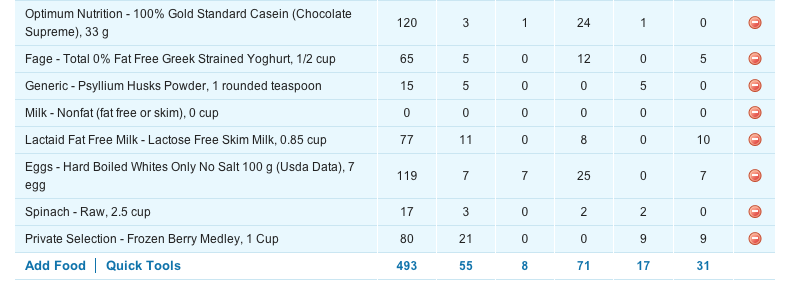
This may be super boring for you to read. I think I am reaching the upper limits of spinach & eggs in shakes. 7 egg whites and 2.5 cups of spinach in today's version. On the plus side, same amount of protein as 3 chicken breasts.


Protein shake al Gaston

I was listening to "The World" today on public radio on my way to get some Drano to clear the kitchen sink, when I heard about a Harvard anthropologist who believes that cooking shaped our bodies evolutionarily speaking. Apparently, in addition to making things tasty and safe to eat, cooking also helps digest food. Makes sense. From a physical perspective, cooking is just using energy to break things apart. Anyway, he thinks that use of fire started over 2 million years ago and pretty much was the reason we could have calories to spare for a big brain. The radio piece here.

However, homo erectus simply never had to deal with donuts--where in nature can you find something that is both high-fat and high-sugar at the same time? Trying to combat the effects of my highly-evolved brain scheming of ways to increase my calories, I have decided to fight back--synapse vs synapse, neuron vs neron, cortex vs cortex. Apparently protein makes you feel full longer, and so I have tried to stay full as long as possible by upping protein to about 50-60% of my diet.

It works. One of the ways is my monster protein shake--which basically turns into a brick in my stomach and keeps me full forever.


This was my attempt at trying to get lots of protein in my belly without getting tons of fat or carbs as well. And it still has to taste good. My lactose intolerance complicates things further. But I found a couple of answers. First, casein is a protein in milk and doesn't cause the problems that lactose does. So I loaded up on that, some yogurt to give it some smoothness, and lactose-free milk. Then I kept adding things to try and up the full factor--more protein, more fiber. Spinach, egg whites, psyllium husks, and a banana. Then ice and water to actually allow it to blend and taste good. I am up to five egg whites per shake. You basically can't taste them and so I keep adding more.

Every afternoon when I am making a shake like this, I sing this to myself (skip to the 2-minute mark):


Maybe 4-dozen, one day, and, unlike Gaston, I am not aiming for barge-size status.

New tools / toolkit

The funny thing about my dad's garage--there are a ton of specialty tools, but some basic tools are lacking. Maybe that's because the kids take them and don't put them back (the oft-repeated refrain from my childhood).

There were two drills and four batteries--nothing held a charge or worked. No circular saw to be seen. And we were experiencing a severe clamp shortage. The universal constant in wood working is "you can never have too many clamps."

So despite my previous shading dealings with people from KSL, I jumped back in the swirl. The good thing about the downturn in the housing market is that there are plenty of people looking to offload tools for a little cash. Either that or a lot of stolen goods are now sold online.

Some of my finds:

18v drill with two batteries (that both hold a charge): $35.


12 used pipe clamps: $55.


I borrowed a circular saw and a biscuit jointer from family--the other great source for tools, relatives that you see infrequently. J/k julie. Maybe.

Photo filter was called "toolkit", which is a word related to "tool" which is what I purchased. Jokes are always funnier when you explain them. Also, I am too lazy to turn the pic of the bar clamps around.

Silhouette in oak

Silhouette is the name of the photo filter. Get it? See what I did there? Well, if I think about, I didn't do much--there is no silhouette of the wood at all. It's like I'm Michael Scott performing for myself, alone, forever....

(Shakes head). Ahhhheeem. One thing that annoys me about Utah is that Craigslist isn't really a thing here. That took me a little while to figure out--craigslist was devoid of anything useful, which is so uncharacteristic. But in order to email anyone about their stuff on KSL Classifieds (apparently, the site of choice here) you have to become a member, fill out a form, provide your real name and physical address, etc. I finally had to actually call someone about their ad.

I eventually found some additional oak from a guy around 33rd south. Of course, everything about it was sketchy. I meet some stranger on a corner in Salt Lake, walk into a deserted ramshackle barn that he says he owns and load up some lumber but "no lights" he said. He had "inherited" it from "a friend". Who bequeaths wood? I mean, in all he had about $2,000 worth of oak there, but it seemed a strange thing to include in a will. But it was a good deal, about $12 for 10/4 x 6" x 6'.

(I threw in a bit of extra lingo there that I picked up--apparently with hardwood, you  say all the thicknesses in quarters so it is easier to calculate board feet. Board feet, of course, is a volume measurement of wood rather than a linear measure. So a board 1 inch by 1 inch by 12 feet is the same price as a board that is 3"x 4"x 1 foot.)


It cleaned up relatively nicely, except for the fact that in the light of day, some of the wood looked a little less appealing. Who knew that when you try to get stuff cheap you often end up getting junk. New concept.

Re-sawing

So part of the lingo I picked up is "re-sawing" which is pretty much just what it sounds like. Apparently, most people are used to getting crap to start with and they have to clean the lumber up. With no big table saw, I ended up using a construction job-site table saw to rip down the beams. How do you cut through a 4" thick oak beam--3/4" of an inch at a time. My only other option was to use a jig saw! (Pause for laughter). Those of you "in the know" will realize I just NAILED a funny power tool joke.

I don't know if it was the right thing to do, but when I split open the beams they were very soggy. I decided to sticker and clamp them while they dried for a week or so. I don't know if it did much besides rust my dad's tools.

Actual workspace

Initially, at least, my setup looked about like this--some german tools, some japanese tools, some american tools, and plenty of chinese tools. In case you can't tell, I am also messing around with my friend's photo software (which is the reason I allowed myself to blog at all).

My new skis

After I cleaned up the beams, I could see just how little I had to work with. One short beam, one big ski, and one rotten former termite home.


Unfortunately, the developer of this house forgot to put 3-phase 220v power into the garage, so that particular table saw is basically just a saw horse.

Century bench on a budget

In getting immersed in this seedy underbelly of personalized workbench construction, I read a lot about how these workbenches built in the old days could last centuries. That had a nice ring to it, so I thought, sure, I will build something that can last 100 years. I figure I am generally handy, but I have never really built any furniture before. Well, that is not exactly true. My cousin Bonny generously paid me far too much to build cabinets with plywood and drywall screws. But this will be my first real "piece." Pretty soon, I will be talking that "portfolio" nonsense and say stuff like "I just really need to focus on my art right now."

But I am trying to do this on a grad school budget. That may conflict with the whole "last a century" bit, but we'll see.

First, find a source of hardwood. It needs to be big. Mass is a key feature of workbenches--you don't want it to wiggle or wobble. Also, if you make something heavy enough, no one will ever want to move it and so it can hide out in a basement for a long time. I found a guy tearing oak beams out of his basement on KSL classifieds. $10 each for the three oak beams and another $5 for the two pine beams.

But as you can see, these beams leave something to be desired.


In fact, some of the wood was basically trash. After I ran it through the thickness planer it showed it's true soul--crooked, rotten, and full of termite holes. I chopped out the worst parts.


Evernote

Eventually I clipped all my notes from all over the web into a virtual notebook on evernote--currently my go-to second brain that keeps track of bips and baps. If you actually care about various design choices and features, there are plenty of links here. If you are just scrolling through posts because you are related to me, I am afraid I don't have many pictures of me to post. But I have lots of oak.

Workbench Design

Niche communities--that is one of the great things about the internet. I wanted some ideas on what would make a killer workbench and, of course, there is a site tailored to just that interest: www.workbenchdesign.net.

That is the entrance to the rabbit hole that, within a week, had me torn up inside. I mean, on the one hand I was very tempted by the traditional French split-top bench Roubo described in his 1774 seminal treatise L'Art du Menuisier. But I can already hear the hissing and booing, I know, I know, I am forgetting the very practical workbench in the style of John Jacob Holtzapffel--a German immigrant to London in 1793 who founded a successful tool-making business.

This paragraph is where I would put a witty little transition to what I actually decided to build. The French-German standoff immediately suggested a World War reference. (I've also recently read a few books by Max Hastings--Armageddon and Retribution which are excellent academic histories and also very engaging reads.) "Battle of the Bulge" is what first came to mind. And I would be able to throw in a short anecdote about trying to lose weight as well. However, crafting that witty paragraph proved too difficult. "And so, like France and Germany almost a century earlier, I waged the Battle of the Bulge in my mind and in my pants." I am sure that would have killed among the lecherous academic historian types.

Anyway, I am incorporating elements of a lot of benches--a bit of a frankenstein. However, the workbenchdesign.net guy had a really nice Shaker style bench that had some interesting features.

His bench:


and his plane storage:

Hiatus

Blogs, what is they good for? I really don't know anymore. I haven't even signed into my google analytics to see if anyone still checks here for updates. But we will see if my much abused audience of about 7 people come back or not.

At the beginning of the year I ran away to Utah to hide and work on my thesis. The good news is that it has been one of my more productive periods in the last five years or so. There really is no bad news. Just that good news. I should be finishing up shortly and (finally) moving on to something a bit different in my life. I don't think I am a professional academic. I am just glad I figured that out before I stumbled my way into a doctoral program.

Since I basically cut off all social contact and temporarily moved to an empty house in the Salt Lake suburbs (my parent's place that they don't use because they are living overseas at the moment), I needed a way to keep myself sane.

I can only write, read, and research so much a day before I start writing nonsense. Some days I have had to throw out several hours worth of work because it was just junk. So--skipping the rest of this long-winded intro--I returned to what I did best as a kid.

And what I did best as a kid was getting into my dad's tools while he wasn't there and working all manner of mischief. I did a small project putting shelves up in the laundry room, but I wanted to find something a little more involved than buying pre-finished parts from massive big-box stores and putting a screw in the wall.

I was a bit frustrated because although there are plenty of tools in the garage, there is really no place to work. After the ah-ha moment, I decided to build a work bench. And like some of my other projects, this has grown a bit over time. It's not done yet, but I have some pics.

Plus, I wanted to try out some new photo-editing software that my friend Tom put out: Camerabag2. So photo (bombs) away.

On gratitude

A talk I wrote a few years ago that I just found. I rather liked it.

Topic

In keeping with today’s topic and the theme of the season, I will speak about gratitude. I pray for the spirit to help guide my remarks and also to help you not get bored.

Ten Lepers

I want to start by jumping in to the story of the ten lepers. Jesus enters into a small village, runs into ten lepers, and heals all ten. Only one thanks Jesus. The Savior responds: “Were there not ten cleansed? but where are the nine?”

This passage from the New Testament is probably the most quoted gratitude scripture. But why is it important? More specifically, why is it important that we understand the reaction of Jesus to the other “nine?” After all, this is the same Jesus that preached: “do not your alms before men, to be seen of them: otherwise ye have no reward of your Father which is in heaven.”

Why did the same Jesus who refused to condemn the woman in adultery, in this case take pains to point out the ingratitude of the nine lepers? Did Jesus need the public recognition? Was he concerned about their private contrition? Did he want to point out that ingratitude was a sin in and of itself? More broadly speaking, why did Jesus emphasize the importance of gratitude? Why does God command us to be grateful?

Scriptural Basis

Book of Mormon and modern prophets also teach this commandment to be grateful.

Alma asks us to “… live in thanksgiving daily.”

The Lord through Joseph Smith asks us to do “…all things with prayer and thanksgiving….”

Also in the D&C, we learn that “…in nothing doth man offend God, or against none is his wrath kindled, save those who confess not his hand in all things, and obey not his commandments.”

The Lord makes the importance of gratitude clear. But why? Nephi teaches us that “He doeth not anything save it be for the benefit of the world….” What, then, is the key to understanding how gratitude helps us?

Definition

To take a step back, in terms of our daily experience, what is gratitude? Or, rather, when do we feel gratitude? I believe that we are likely to experience gratitude when we receive something that:
(1)we value
(2)is costly to the person who gives the gift
(3)is given with good intentions (for example, not predicated on reciprocity), and
(4)is given freely rather than out of a role-based obligation

If you apply this framework to the scriptures then the commandment to be grateful is really just an invitation:
(1)to value what God values,
(2)to “spend” or sacrifice what God spends and sacrifices,
(3)to develop God’s “good” intent (in other words, develop charity) and,
(4)to change our natures

Apply to Scriptures

The scriptures, which before seemed so strict and almost militant in commanding us to confess the hand of God in all things, take on new meaning. Let’s take three examples.

In the D&C we read that “… he who receiveth all things with thankfulness shall be made glorious; and the things of this earth shall be added unto him, even an hundred fold, yea, more.” This is entirely logical. If we “receive all things with thankfulness” we will value those things that God values and in all situations strive to act as God would. If we do this, the Lord has promised that we will be joint heirs in his kingdom.

For another example, consider the Lord’s call to build a temple in D&C 97. Notice how the Lord explains what purpose a temple will serve in establishing Zion. [The temple is]:
13 … a place of thanksgiving for all saints, and … a place of instruction for all those who are called to the work of the ministry …;
14 That they may be perfected in the understanding of their ministry, in theory, in principle, and in doctrine, in all things pertaining to the kingdom of God on the earth….

You can interpret this explanation in a few ways. One way is that a temple has several purposes, one of which is as a place to give thanks. Another way is that a temple has a singular purpose—the salvation of Zion. Giving thanks, receiving instruction, and perfecting our understanding are all ways expressing this same purpose. Regardless of how you read the verse, how often do we explain the purpose of the temple as a place to give thanks?

If, however, we interpret God’s command to “give thanks in all things” as synonymous with the Savior’s invitation “to be ye therefore perfect, even as your Father which is in heaven is perfect” then the role of the temple as a place of thanksgiving becomes clear. In the temple we learn about pre-mortal life, the creation, the fall, the resurrection, and the atonement. We learn about the nature of God and we make covenants to change our nature to become like His. We commit to sacrifice what he sacrificed (His everything), and learn to be obedient because of our love for Him. In short, we begin to value what he values, we better appreciate the cost of his sacrifice, and we learn of the benevolent intentions of our Father and our Savior.

Joseph Smith taught “If men do not comprehend the character of God, they do not comprehend themselves.” Combining these ideas, I think the Lord is telling us that it is in giving thanks that we truly come to understand ourselves.

For another example, consider Laman and Lemuel. According to our framework, when you give thanks for something you first learn how God would view that thing and then strive to view it in the same way. Murmuring is the opposite of giving thanks--you persist in your own view and refuse to find out the will of God.

The Book of Mormon describes the exhortations given to Laman and Lemuel as “… hard to be understood, save a man should inquire of the Lord; and they being hard in their hearts, therefore they did not look unto the Lord as they ought.”

Later, Nephi writes “And thus Laman and Lemuel, … did murmur … because they knew not the dealings of that God who had created them” (1 Ne. 2:12; see also Mosiah 10:14).

Laman and Lemuel became rebels instead of leaders because of their failure to understand either the character or the purposes of God. They did not understand, at least in part, because they were ungrateful.

Practical Application

Understanding gratitude as an invitation to become like God is certainly an interesting exercise. To some extent, this definition is self-serving. I was assigned to speak on gratitude and somehow found a way to conflate almost every other major gospel principle into it. But how will applying this framework help us to live the gospel? What practical application does it have? What does it change? Two examples I can think of.

First, it can change how we “count our blessings.” Personally, when I view giving thanks as a way to investigate the nature of God, the quantitative element in gratitude begins to subside. Counting or list making becomes less important. Motivation and consistency become more important. The Book of Mormon is a blessing. Check. I am thankful for the Book of Mormon. I prayed as much this morning. I express my gratitude by reading and applying the teachings of the Book of Mormon to become like God? Work in progress.

I am striving to replace the quantitative “count your blessings” model of gratitude with what Neal A Maxwell describes as “inventorying your insights.” If blessings are isolated data points then insights are the trends and messages those data convey. Am I “giving thanks” without becoming more like God? Where are the data points clustered? In the last ten years, when have I been the most blessed? What was I doing then? What can I change?

Henry B Eyring has his own method to count blessings--every day he writes a short journal entry responding to the question “How has the Lord blessed me today.” It is an excellent technique and I am not one to criticize it. But perhaps another way to phrase that question would be “How have I used my blessings to become more like God today?”

Second, it can change how we pray.

In D&C 46 the Lord through Joseph Smith says “…ye must give thanks unto God in the Spirit for whatsoever blessing ye are blessed with.” Notice the phrase “in the Spirit.”

Next, in John, the Lord says: “But the Comforter, which is the Holy Ghost, whom the Father will send in my name, he shall teach you all things, and bring all things to your remembrance, whatsoever I have said unto you.”

Prayer is the act by which the will of the Father and the will of the child are brought into correspondence with each other. Our wills and desires are more than just what we want, they also include what we value. Just like I can ask amiss, I can give thanks incorrectly. I am often too thankful--both in words and in action--for a job, an education, friends, a car, and an apartment. Are those the things God values most in my life?

In light of these scriptures and this framework, I can better understand that giving thanks is not merely a precursor to the main work of prayer--asking for forgiveness or pleading for blessings--but it is an essential method of communicating to my Father in Heaven that our wills truly are converging.

Conclusion

To summarize, gratitude is:
(1)to value what God values,
(2)to “spend” or sacrifice what God spends and sacrifices,
(3)to develop charity and,
(4)to change our natures

If we revisit the ten Lepers, this context can change our view of Christ’s reaction. With His ministry perhaps largely completed, ten lepers showed faith by lifting up their voices and saying “Master, have mercy on us.” He blessed all ten lepers with healing and a confirmation of their faith. Only one demonstrated that his faith was enduring, that he recognized the source of his blessing, and that he sought truly to become like God.

In this light, Christ’s rejoinder “Were there not ten cleansed? but where are the nine?” is not accusatory at all. Rather, perhaps the tone of the Savior’s response is similar to the Lord of vineyard in the allegory of the wild olive tree. After working fruitlessly for many, many seasons the Lord of the vineyard wept and asked his servant: “What more could I have done for my vineyard?”

I pray that we all, myself included, take advantage of our opportunities to give thanks to God and in doing so, become more like him. JC. Amen.

sleepy

It's early, he murmured, and by this he meant, as became immediately apparent, that he still had time to punish himself for his frivolity in having exchanged obligation for devotion, the authentic for the false, the enduring for the transient.

That's from Jose Saramago, a Portugese Nobel laureate from a few years ago. Sadly, despite good intentions, I spent an evening exchanging the authentic for the false--i.e., I caught up on some TV instead of working on my model as I was supposed to.

I wanted to log on somewhere and leave some sort of cutting remark--the online equivalent of opening up a window and shouting at the world. But when everyone from my mom to my future employer has little bots scurrying about the web gathering bits and bytes, a random internet scream seems less relieving than it used to.

Instead, a quote, a musing, and off to bed. To bed I said. Did you know that Dr. Seuss is not pronounced the way we grew up pronouncing it? The correct pronunciation rhymes with voice, not loose. The more you know.... (Also, four periods is the proper way to shorten a sentence with an elipsis while at the same time ending a thought). However, I wonder if putting punctuation outside of "quotation marks", such as the example I just made, applies to thoughts in parens. The fads of punctuation seem quite ephemeral. But I should at least consistently apply that fad. Hopefully I will in the future. And yes, I mean I definitely will do so in a hopeful way, not that I may possibly do so in an adjective-less manner.

I am quite pleased with myself, despite the unbalanced parallelism that I began that last paragraph with. I am not supposed to end with a with, but it sounded more natural than "despite the unbalanced parallelsim with which I began that last paragraph". Perhaps the awkwardness of both constructions indicates that I need to shake things up a bit. "Despite beginning the last paragraph with an unbalanced parallel structure, I am quite please with myself" seems like a better option, but one that clearly shows I rewrote it three times. I guess that is the paradox--writing that looks effortless comes out after the 11th or 12th draft, while effortless writing looks like the 11th or 12th draft of a tortured legal contract. Anything in between is sad. It's sad because a whole generation of know-it-all whipper snappers have tried to emulate skilled writers like Wallace or Eggers and move in and out of different layers of the text, but fail to highlight anything new or different. Instead, they are stuck in endless, selfish recursion.

Good Content

When I am running, cleaning, or driving I often listen to talks and speeches of various sorts to keep me occupied and, hopefully, to make me a little smarter. This post is really just rewording an email I sent to a friend telling him that I uploaded some files that we had talked about.

  • The Moth: website, podcast link; zipped full archive here; 10-20 minute stories told live by “professional” story-tellers (everyone from academics to comedians).
  • SALT: website, podcast link; archive from podcast link, or zipped partial archive here; 60-90 minute speeches that fit in with the title “Seminars About Long-term Thinking”, with long-term meaning the next 10,000 years.
  • On the Media: website, podcast link; archive from podcast link; 50 minute meta-news--news about the news including media, media coverage, media bias, conflicts of interest, etc.
  • Maxwell: from lds and byu speeches; (almost) all spoken and written talks zipped here.
  • Eyring: from lds and byu speeches; (almost) all spoken and written talks zipped here.
  • Mormon Stories: website, podcast link; selected episodes here; hundreds of interviews with Mormons of all stripes, some pushing their own agenda and biases a lot more forcefully than others, lots of chaff but some grain.

EDIT: Updated the links so they aren't broken. Files uploading overnight, may be a while until they are all online.

Mesmerizing

Not on the promotional site

They won't tell you that having a mask that keeps positive pressure on your mouth all night long can, in effect, pressurize your digestive tract.  Yeah, that's right, I swallow air, and because the pressure is constant for hours, I wake up with a huge belly full of inflated guts.  Sort of funny, sort of uncomfortable.